
Dive into your financial future, anticipate your gains and build a solid strategy: discover today what your investments can bring you tomorrow with our compound interest calculator.
Compound Interest Calculator
Results
Guide on Compound Interest and Using Our Calculator
In the vast world of finance, the concept of compound interest is a pillar. This phenomenon, often called "the eighth wonder of the world", has the power to transform modest savings into a real treasure. At the heart of this transformation is the compound interest simulator, an invaluable tool that allows you to project your financial future. Here we reveal the secrets of compound interest through our calculation tool.
Compound Interest: Definition
Before diving into the vast world of finance and investment, it is essential to master certain key concepts. Among them, compound interest stands out as one of the most fundamental notions. It is often thanks to this that savers see their capital grow impressively over the years. But what does this really mean, and what makes it so special?
What is Compound Interest?
Let's break down the concept to better understand it. Imagine that you place a certain sum of money in an account earning a defined interest rate. After a period, often one year in many cases, you will earn interest on this sum. If you leave this interest in the account and don't touch anything, it will be added to the initial capital, and in the following period, the interest rate will apply to this new total amount. Thus, your interest generates its own interest. This is the mechanism we call "compounding".
How does it differ from simple interest?
With simple interest, the situation is different. If you invest a sum of money at a given interest rate, you will earn interest on your initial capital each year, but this interest is not reinvested. It is usually paid directly to the account holder, and the initial capital does not change. Therefore, the amount of interest received each year remains constant.
However, with compound interest, the amount of interest received increases each year because it is calculated on a constantly growing base, which includes previously earned interest.
How is it Beneficial for a Saver?
Compound interest is like a faithful friend for the patient saver. It allows your savings to grow at a much faster rate than with simple interest. The longer you leave your money invested, the more pronounced the compounding effect becomes. This can transform small, regularly invested sums into a substantial nest egg over the years. This is why many financial advisors recommend starting to save and invest as soon as possible, even if the amounts are modest at first. Thanks to compound interest, these small sums can accumulate to become a fortune.
This is why many financial advisors recommend starting to save and invest as soon as possible, even if the amounts are modest at first. Thanks to compound interest, these small sums can accumulate to become a fortune.
The Power of Compound Interest
The universe of finance is full of concepts, some simple, others more complex. While some of these concepts may seem esoteric, others have the power to profoundly influence how we perceive and manage our money. Among them, compound interest stands out for its amazing ability to transform modest savings into a flourishing treasure. So why is this mechanism so special and how can it have such a monumental impact on your finances?
In the following paragraphs, you'll discover the unsuspected potential behind this financial formula which, when well utilized, can work wonders.
The Magic of Compounding
Let's first talk about this "eighth wonder of the world". Compound interest is often praised for its ability to make money work in an almost magical way. In reality, it's not magic, but simple mathematics that works exponentially. The longer you leave your money invested, the more you benefit from the power of compounding. Each year, earned interest is added to the capital, and the following year, interest is earned on this total amount, and so on.
The Snowball Effect of Your Capital
Let's take the snowball analogy. At first, when it starts rolling down the slope, it's small and seems insignificant. But as it rolls, it captures more snow, grows, and accelerates.
This is exactly what happens with compound interest. Your initial gains might seem modest, but over time, these initial gains, when reinvested, generate their own gains. This continuous accumulation reinforces the growth of your investment, turning small initial amounts into a considerable sum over time.
Long-term Benefits
Where the power of compound interest really shines is in the long term. Over shorter periods, the difference with simple interest may seem negligible. But spread this investment over 10, 20, or 30 years, and the difference becomes stunning. This is why many financial experts emphasize the advantage of starting to invest early, even if the initial amounts seem small. Over time, compounding will do its work, and you might be amazed to see how much your savings have increased, simply thanks to the power of compound interest.
Benefits of Compound Interest
When it comes to saving and investing, not all financial mechanisms are equal. While some offer immediate benefits, others, like compound interest, stand out for their ability to maximize the value of your investments over the long term. Understanding these benefits can transform your investment perspective and lead you to surprising financial growth.
Encouraged Investment Discipline
Compound interest also has the merit of cultivating a certain discipline in the investor. By understanding the potential of this financial mechanism, you are more inclined to adopt a long-term investment strategy. Instead of withdrawing gains immediately, you might be tempted to let them accumulate to maximize the benefits of compounding. This patience is rewarded: the longer you let your savings grow uninterrupted, the more you benefit from cumulative interest. This encourages not only early investment but also avoiding impulsive withdrawals.
By adopting this discipline, your savings are more exposed to the exponential potential of compound interest, paving the way for optimal capital growth.
Optimizing Returns Over Time
One of the great advantages of compound interest is that it rewards patience. Savers who invest for the long term will see their returns grow exponentially. Thus, even with a modest interest rate, savers can hope for significant returns over long periods. By combining this patience with regular contributions, even minimal ones, the growth potential becomes considerable.
An Ally for Diversifying Your Investments
Integrating the power of compound interest into your financial strategy can also encourage you to diversify your investments. By seeking different financial products offering compound interest, such as savings accounts, PEAs, stocks, ETFs, and others, you can take advantage of various opportunities while spreading risks. This diversification, combined with the power of compound interest, can result in solid and sustainable growth of your financial portfolio.
Compound Interest Calculation Methods
Before embarking on the investment adventure and seeing your capital grow, it is essential to understand the engine that drives this growth: the compound interest formula. Behind this somewhat technical term lies a powerful concept which, once mastered, can become an invaluable asset in your financial strategy.
Decoding the Compound Interest Formula
At the heart of the compound interest mechanism is a mathematical formula which, although it may seem complex at first glance, is actually quite straightforward. The formula is as follows:
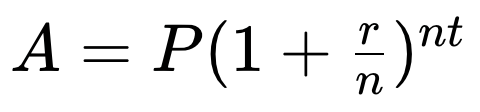
where:
- A is the final amount after the investment period.
- P represents the initial capital, that is, the sum of money you initially invest.
- r is the annual interest rate (in decimal form, for example, 5% would be 0.05).
- n is the number of times interest is compounded per year.
- t is the number of years the money is invested.
Simulation Tools
If handling this formula seems laborious to you, you're not alone. This is why many investors rely on tools like our compound interest calculator. These tools have been designed to simplify the task by offering an intuitive interface where you just need to enter your investment parameters. In a few clicks, you get a precise estimate of your savings growth thanks to compounding.
Variables to Consider
Beyond the simple formula, several variables can influence the calculation of compound interest. Among these, the frequency of compounding holds a central place.
Indeed, interest can be compounded annually, semi-annually, quarterly, monthly, or even daily in some cases. This frequency will have a significant impact on the total amount at the end of the investment period. On the other hand, some investments, such as PEAs in the stock market or ETFs, may have their own specificities affecting the return.
Relying on Compound Interest Simulators
The digital age has made access to compound interest simulators easier than ever. These simulators, available online, allow you to explore various scenarios based on your financial ambitions. They take into account all variables, from initial capital to interest rate to duration, to give you a clear picture of your investment's trajectory. By using our compound interest calculator, you can adjust your investment strategy and thus maximize your returns.
How to use our compound interest calculator
Our compound interest calculator is designed to be intuitive. Simply enter the required data: initial amount, regular deposit amount, interest rate, duration, and payment frequency. With one click, discover the growth potential of your investment.
- Initial data entry: start by entering the initial deposit amount, that is, the sum you plan to invest. Then indicate the amount of regular deposits.
- Payment frequency: choose the frequency of your payments. Do you want to invest a sum monthly or annually? Your choice will affect the final result, as it determines how many times interest is compounded during a year.
- Define the interest rate: The interest rate is a determining factor in evaluating the future growth of your investment. You can refer to information provided by your bank or financial advisor to fill this in.
- Specify the duration: The duration represents the time during which you plan to leave your money invested. It is expressed in years.
Get Results in One Click
Once all your data is entered, all you have to do is launch the calculation. In a few moments, our calculator presents you with the total amount you could accumulate at the end of the investment period. It's an efficient and quick way to visualize the potential of your savings.
The Rule of 72
This rule is a quick method to estimate the time needed to double an investment, based on a fixed interest rate. Simply divide 72 by the annual interest rate to get an estimate of the number of years needed. This rule is a quick method to estimate the time needed to double an investment, based on a fixed interest rate. Simply divide 72 by the annual interest rate to get an estimate of the number of years needed.
Origin of the Rule of 72
The Rule of 72 is an age-old mathematical trick used by investors to get a quick idea of their investment's potential. It relies on a logarithmic approximation and, although not absolutely precise, it provides a close enough indication for most common needs.
Simplified Calculation for Doubling
The idea behind this rule is to offer a simple method to estimate how long it will take for your investment to double, based on a given interest rate. To apply it, take the number 72 and divide it by the annual interest rate (expressed as a percentage). The result gives you an estimate of the number of years needed.
Let's take an example to better visualize. If you have an investment that yields an annual interest rate of 6%, the Rule of 72 suggests that it will take about 12 years for your capital to double (72 ÷ 6 = 12).
Limitations of the Rule of 72
Although this rule is practical, it is not perfect. It works best for interest rates between 6% and 10%. For rates outside this range, adjustments may be necessary. For example, for very low or very high rates, some recommend using 70 or 73 instead of 72 for a better approximation.
Consider the Rule of 72 as a tool to add to your investor's toolkit. It is not meant to replace more detailed calculations or professional financial advice, but it can be an excellent way to get a quick overview of your investment's potential growth.
The Importance of Starting Early
The earlier you start investing, the more you benefit from the power of compound interest. The additional years allow your accumulated interest to work in your favor.
Minimal Efforts for Majestic Gains
Starting early doesn't necessarily mean investing large sums of money. Rather, it's about giving your money as much time as possible to work for you. Even modest amounts, invested regularly from the start, can lead to impressive sums in the long term.
Don't Regret, Act
If you're reading this and think it's already too late for you, think again. Better late than never. If you haven't started early, start now. Every year, every month, every day counts. Give your money the time and space to fully benefit from the magic of compound interest.
Pitfalls to Avoid with Compound Interest
One of the main pitfalls is withdrawing gains too early. Withdrawals reduce the base on which interest is calculated, thus limiting exponential growth.
The Counterproductive Effect of Premature Withdrawals
While compound interest is a powerful force, withdrawing funds impulsively can seriously erode this power. Each time you withdraw gains, you not only deprive your portfolio of that precise amount but also of all future interest that money could have generated.
The Short-term Temptation
Faced with immediate financial needs or impulsive desires, it can be tempting to dip into your savings. However, each withdrawal made is a missed opportunity to benefit from the continuous growth that compound interest can offer.
Hidden Fees, Silent Enemies
Also pay attention to fees associated with certain investments. High fees or hidden charges can eat into your returns, making compound interest less effective. Make sure you understand the costs associated with each investment.
The Illusion of a High Interest Rate
It's easy to be seduced by offers with exceptionally high interest rates. However, these offers may hide equally high risks. A higher return often means higher risk. Always evaluate the risk level against the potential return.
Patience is a Virtue
When it comes to compound interest, patience is key. Resist the temptation to withdraw your funds prematurely and give your investment time to grow. Your future self will thank you.
Factors Influencing Compound Interest
The interest rate, compounding frequency, and investment duration are key elements. Investing in financial instruments such as PEA, stocks, or ETFs can offer different returns.
The Weight of the Interest Rate
The interest rate plays a crucial role in calculating compound interest. A higher interest rate allows, with equal capital and duration, to benefit from a more substantial return. However, it is essential to keep in mind that higher rates can often be associated with increased risks. It is therefore important to find a balance between the desired return and the level of risk you are willing to accept.
Compounding Frequency: A Silent Multiplier
The frequency at which interest is compounded can greatly influence the final amount of your investment. Whether it's annual, semi-annual, quarterly, monthly, or daily compounding, each increase in frequency accelerates the growth of your capital. Thus, the more frequently interest is compounded, the more noticeable the accumulation effect will be.
Investment Duration: The Power of Time
The longer the investment duration, the more the potential of compound interest manifests. By letting your capital grow over an extended period, you give more opportunities for your interest to generate its own interest, thus creating a dynamic of exponential growth.
Financial Instruments: Diverse Playgrounds
The choice of financial instrument in which to invest is important. Each product, whether it's a PEA, stocks, or ETFs, has its own characteristics in terms of return, taxation, and risk.
The PEA, for example, offers tax advantages after five years but limits withdrawals. ETFs, on the other hand, allow you to diversify your investments by tracking an index. As for the stock market, it offers high potential gains, but it is also associated with volatility that can be a source of uncertainty.
Informed Selection and Vigilance
Whatever your investment choice, always inform yourself thoroughly about the characteristics and associated risks. A wise investment in the context of compound interest relies on a clear understanding of the different factors at play.
Practical Applications of Compound Interest in Daily Life
Compound interest plays a crucial role in various everyday life scenarios, whether it's saving for retirement, repaying loans, or planning for higher education.
Saving for Retirement: The Art of Patience
When it comes to retirement savings, compound interest is a formidable ally. Imagine setting aside a modest sum each month from the start of your career. Thanks to the magic of compounding, this sum, even if minimal, can grow significantly over several decades. You don't need to be a big saver to benefit from this effect; regularity and duration are the keys. The earlier you start, the more you maximize the beneficial effects of compounding.
Loan Repayment: Understanding the Other Side
While compound interest is a great savings tool, it can prove to be a tough opponent when it comes to debt. Take the example of a consumer credit or mortgage loan. If interest is compounded, the amount of your debt can increase rapidly, especially if you only repay the minimum required. It is therefore essential to understand how interest compounding works to better manage and plan your repayments.
Planning for Higher Education: An Investment for the Future
Financing higher education is often a challenge for many households. However, with a bit of anticipation and the power of compound interest, it is possible to amass a substantial sum for the future student in the family. By starting to save from the child's birth, or even their first steps at school, you benefit from many years to see your capital grow. When the time comes to enter university, these savings, nourished by compound interest, can significantly lighten the cost of studies.
Every Decision Counts
In everyday life, compound interest often comes into play without us even realizing it. Whether you're looking to grow your savings, avoid mounting debt, or prepare for your children's future, always keep in mind the potential of this tool. A wise financial decision today can have lasting positive effects.
Don't Waste Time: Take Advantage of the Power of Compound Interest Now
The magic of compound interest lies in its ability to grow your capital exponentially. By understanding how it works, you open the door to financial opportunities that can prove beneficial in the long term. Our compound interest calculator is designed to give you a clear view of your investment's potential growth. With this tool, no need to juggle with mathematical formulas. You can easily estimate returns on investment based on various scenarios. Making informed decisions today is the guarantee of financial security tomorrow. By having a clear vision of the impact of compound interest on your investments, you can better guide your financial choices and thus prepare a serene future for you and your loved ones. This guide is just the beginning of your financial adventure. Armed with knowledge and appropriate tools, you are now ready to navigate confidently in the world of investment. Each step, each decision, each investment is an additional brick in building your future. Good luck with your financial projects!